Constructing Pseudowords with Constraints on Morphological Features - Application for Polish Pseudonouns and Pseudoverbs
Joanna Daria Dołżycka, Jan Nikadon, Magdalena Formanowicz
Abstract
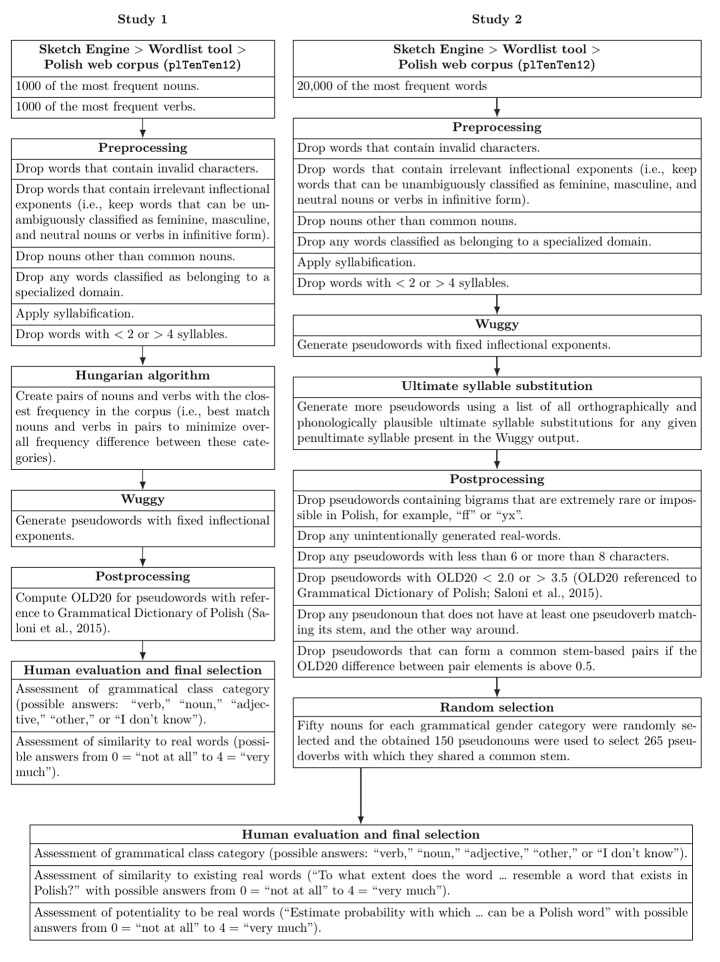
Pseudowords allow researchers to investigate multiple grammatical or syntactic aspects of language processing. In order to serve that purpose, pseudoword stimuli need to preserve certain properties of real language. We provide a Python-based pipeline for the generation of pseudoword stimuli that sound/read naturally in a given language. The pseudowords are designed to resemble real words and clearly indicate their grammatical class for languages that use specific suffixes from parts of speech. We also provide two sets of pseudonouns and pseudoverbs in Polish that are outcomes of the applied pipeline. The sets are equipped with psycholinguistically relevant properties of words, such as orthographic Levenshtein distance 20. We also performed two studies (overall N = 640) to test the validity of the algorithmically constructed stimuli in a human sample. Thus, we present stimuli that were deprived of direct meaning yet are clearly classifiable as grammatical categories while being orthographically and phonologically plausible.
§ The Valyu brief
Reading the full paper and taking notes. This takes a few seconds…
§ Ask this paper
Ask a question about this paper
Valyu reads the full text and answers from what the paper actually says.
Searching the other archives…