Braille letter reading: A benchmark for spatio-temporal pattern recognition on neuromorphic hardware
Simon F. Müller-Cleve, Vittorio Fra, Lyes Khacef, Alejandro Pequeño-Zurro, Daniel Klepatsch, Evelina Forno, Diego G. Ivanovich, Shavika Rastogi, Gianvito Urgese, Friedemann Zenke, Chiara Bartolozzi
Abstract
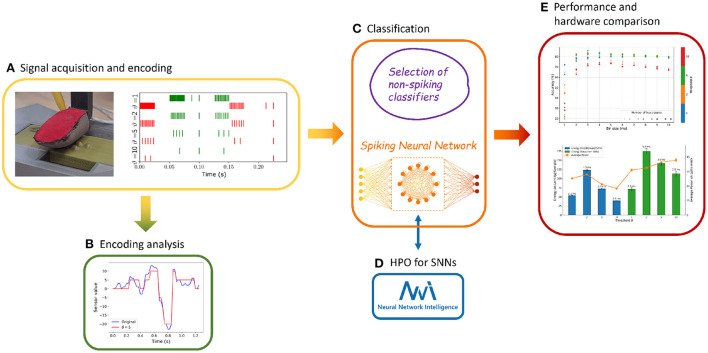
'Alejandro Pequeño-Zurro' 'Daniel Klepatsch' 'Evelina Forno' 'Diego G. Ivanovich' 'Shavika Rastogi' 'Gianvito Urgese' 'Friedemann Zenke' 'Chiara Bartolozzi'] Spatio-temporal pattern recognition is a fundamental ability of the brain which is required for numerous real-world activities. Recent deep learning approaches have reached outstanding accuracies in such tasks, but their implementation on conventional embedded solutions is still very computationally and energy expensive. Tactile sensing in robotic applications is a representative example where real-time processing and energy efficiency are required. Following a brain-inspired computing approach, we propose a new benchmark for spatio-temporal tactile pattern recognition at the edge through Braille letter reading. We recorded a new Braille letters dataset based on the capacitive tactile sensors of the iCub robot's fingertip. We then investigated the importance of spatial and temporal information as well as the impact of event-based encoding on spike-based computation. Afterward, we trained and compared feedforward and recurrent Spiking Neural Networks (SNNs) offline using Backpropagation Through Time (BPTT) with surrogate gradients, then we deployed them on the Intel Loihi neuromorphic chip for fast and efficient inference. We compared our approach to standard classifiers, in particular to the Long Short-Term Memory (LSTM) deployed on the embedded NVIDIA Jetson GPU, in terms of classification accuracy, power, and energy consumption together with computational delay. Our results show that the LSTM reaches ~97% of accuracy, outperforming the recurrent SNN by ~17% when using continuous frame-based data instead of event-based inputs. However, the recurrent SNN on Loihi with event-based inputs is ~500 times more energy-efficient than the LSTM on Jetson, requiring a total power of only ~30 mW. This work proposes a new benchmark for tactile sensing and highlights the challenges and opportunities of event-based encoding, neuromorphic hardware, and spike-based computing for spatio-temporal pattern recognition at the edge.
§ The Valyu brief
Reading the full paper and taking notes. This takes a few seconds…
§ Ask this paper
Ask a question about this paper
Valyu reads the full text and answers from what the paper actually says.
Searching the other archives…