Turing pattern–based design and fabrication of inflatable shape-morphing structures Turing Pattern Based Design of Morphing Structures
Masato Tanaka, S. Macrae Montgomery, Liang Yue, Yaochi Wei, Yuyang Song, Tsuyoshi Nomura, H. Jerry Qi
Abstract
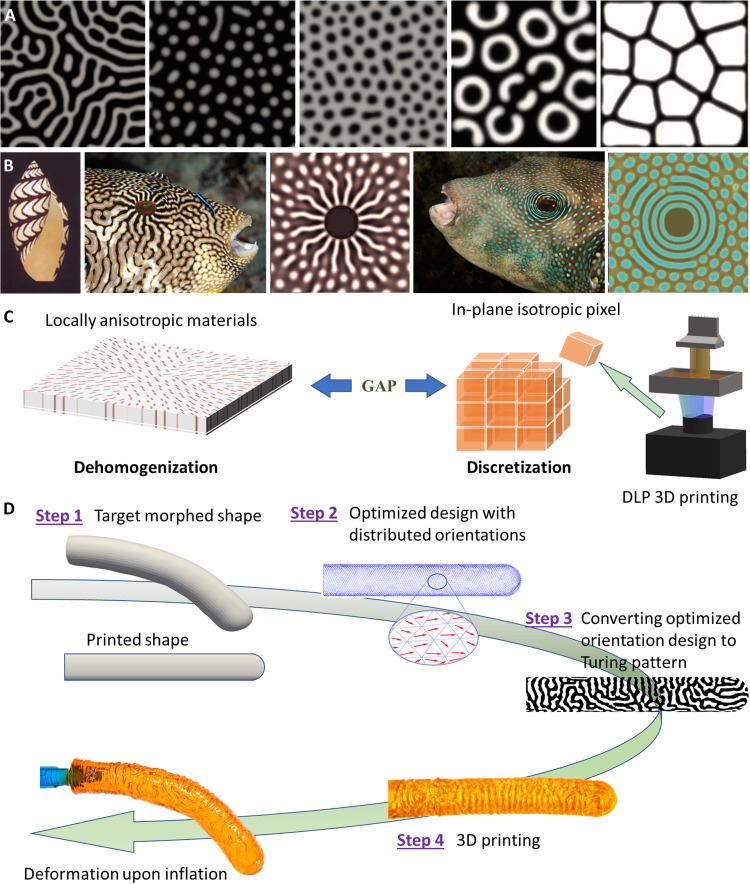
'Yuyang Song' 'Tsuyoshi Nomura' 'H. Jerry Qi'] Turing patterns are self-organizing stripes or spots widely found in biological systems and nature. Although inspiring, their applications are limited. Inflatable shape-morphing structures have attracted substantial research attention. Traditional inflatable structures use isotropic materials with geometrical features to achieve shape morphing. Recently, gradient-based optimization methods have been used to design these structures. These methods assume anisotropic materials whose orientation can vary freely. However, this assumption makes fabrication a considerable challenge by methods such as additive manufacturing, which print isotropic materials. Here, we present a methodology of using Turing patterns to bridge this gap. Specifically, we use Turing patterns to convert a design with distributed anisotropic materials to a distribution with two materials, which can be fabricated by grayscale digital light processing 3D printing. This work suggests that it is possible to apply patterns in biological systems and nature to engineering composites and offers new concepts for future material design.
§ The Valyu brief
Reading the full paper and taking notes. This takes a few seconds…
§ Ask this paper
Ask a question about this paper
Valyu reads the full text and answers from what the paper actually says.
Searching the other archives…