The Role of miR-103 and miR-107 in Regulation of <i> CDK5R1 </i> Expression and in Cellular Migration miR103/107 Regulate <i> CDK5R1 </i> Reducing Cell Migration
Silvia Moncini, Alessandro Salvi, Paola Zuccotti, Gabriella Viero, Alessandro Quattrone, Sergio Barlati, Giuseppina De Petro, Marco Venturin, Paola Riva, Michael Polymenis
Abstract
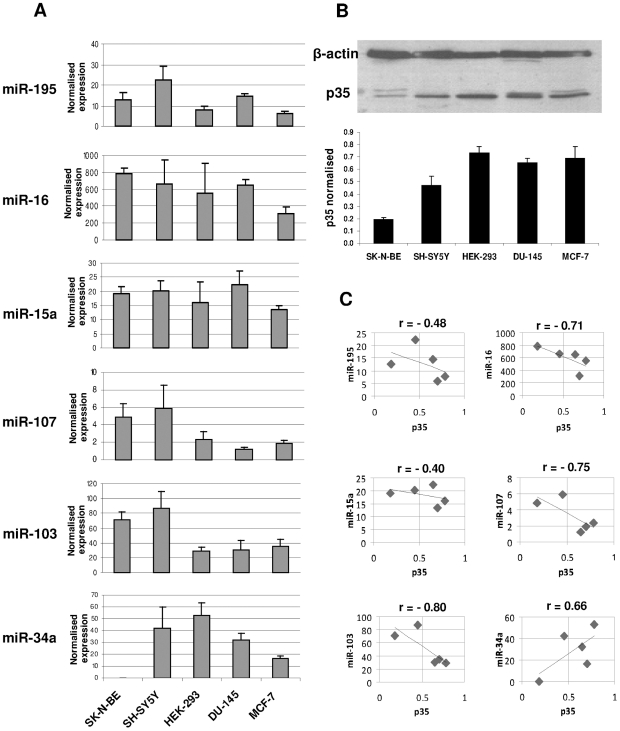
'Alessandro Quattrone' 'Sergio Barlati' 'Giuseppina De Petro' 'Marco Venturin' 'Paola Riva' 'Michael Polymenis'] CDK5R1 encodes p35, a specific activator of the serine/threonine kinase CDK5, which plays crucial roles in CNS development and maintenance. CDK5 activity strongly depends on p35 levels and p35/CDK5 misregulation is deleterious for correct CNS function, suggesting that a tightly controlled regulation of CDK5R1 expression is needed for proper CDK5 activity. Accordingly, CDK5R1 expression was demonstrated to be controlled at both transcriptional and post-transcriptional levels, but a possible regulation through microRNAs (miRNAs) has never been investigated. We predicted, within the large CDK5R1 3′UTR several miRNA target sites. Among them, we selected for functional studies miR-103 and miR-107, whose expression has shown a strong inverse correlation with p35 levels in different cell lines. A significant reduction of CDK5R1 mRNA and p35 levels was observed after transfection of SK-N-BE neuroblastoma cells with the miR-103 or miR-107 precursor (pre-miR-103 or pre-miR-107). Conversely, p35 levels significantly increased following transfection of the corresponding antagonists (anti-miR-103 or anti-miR-107). Moreover, the level of CDK5R1 transcript shifts from the polysomal to the subpolysomal mRNA fraction after transfection with pre-miR-107 and, conversely, from the subpolysomal to the polysolmal mRNA fraction after transfection with anti-miR-107, suggesting a direct action on translation efficiency. We demonstrate, by means of luciferase assays, that miR-103 and miR-107 are able to directly interact with the CDK5R1 3′-UTR, in correspondence of a specific target site. Finally, miR-103 and miR-107 overexpression, as well as CDK5R1 silencing, caused a reduction in SK-N-BE migration ability, indicating that these miRNAs affect neuronal migration by modulating CDK5R1 expression. These findings indicate that miR-103 and miR-107 regulate CDK5R1 expression, allowing us to hypothesize that a miRNA-mediated mechanism may influence CDK5 activity and the associated molecular pathways.
§ The Valyu brief
Reading the full paper and taking notes. This takes a few seconds…
§ Ask this paper
Ask a question about this paper
Valyu reads the full text and answers from what the paper actually says.
Searching the other archives…