Personalized symptom management: a quality improvement collaborative for implementation of patient reported outcomes (PROs) in ‘real-world’ oncology multisite practices
Doris Howell, Zeev Rosberger, Carole Mayer, Rosanna Faria, Marc Hamel, Anne Snider, Denise Bryant Lukosius, Nicole Montgomery, Mindaugas Mozuraitis, Madeline Li
Abstract
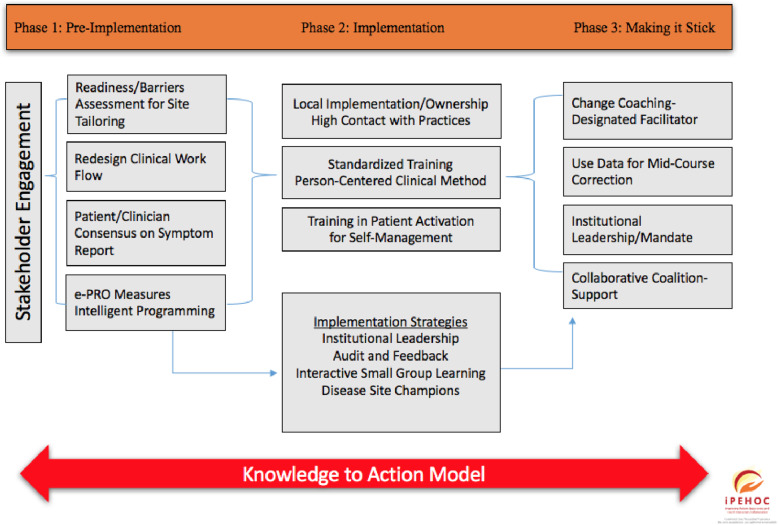
'Marc Hamel' 'Anne Snider' 'Denise Bryant Lukosius' 'Nicole Montgomery' 'Mindaugas Mozuraitis' 'Madeline Li' ''] Background Little research has focused on implementation of electronic Patient Reported Outcomes (e-PROs) for meaningful use in patient management in ‘real-world’ oncology practices. Our quality improvement collaborative used multi-faceted implementation strategies including audit and feedback, disease-site champions and practice coaching, core training of clinicians in a person-centered clinical method for use of e-PROs in shared treatment planning and patient activation, ongoing educational outreach and shared collaborative learnings to facilitate integration of e-PROs data in multi-sites in Ontario and Quebec, Canada for personalized management of generic and targeted symptoms of pain, fatigue, and emotional distress (depression, anxiety). Patients and methods We used a mixed-methods (qualitative and quantitative data) program evaluation design to assess process/implementation outcomes including e-PROs completion rates, acceptability/use from the perspective of patients/clinicians, and patient experience (surveys, qualitative focus groups). We secondarily explored impact on symptom severity, patient activation and healthcare utilization (Ontario sites only) comparing a pre/post population cohort not exposed/exposed to our implementation intervention using Mann Whitney U tests. We hypothesized that the iPEHOC intervention would result in a reduction in symptom severity, healthcare utilization, and higher patient activation. We also identified key implementation strategies that sites perceived as most valuable to uptake and any barriers. Results Over 6000 patients completed e-PROs, with sites reaching 51%-95% population completion rates depending on initial readiness. e-PROs were acceptable to patients for communicating symptoms (76%) and by clinicians for treatment planning (80%). Patient experience was better than the provincial average.
§ The Valyu brief
Reading the full paper and taking notes. This takes a few seconds…
§ Ask this paper
Ask a question about this paper
Valyu reads the full text and answers from what the paper actually says.
Searching the other archives…