Reaching 80 Years of Age: Clinical, Behavioral, and Psychosocial Related Risk Factors in a Large Cohort of Israeli Working Men
Shahar Lev-Ari, Anne Marie Novak, Adva Zemer, Yariv Gerber, Uri Goldbourt, Jaakko Tuomilehto
Abstract
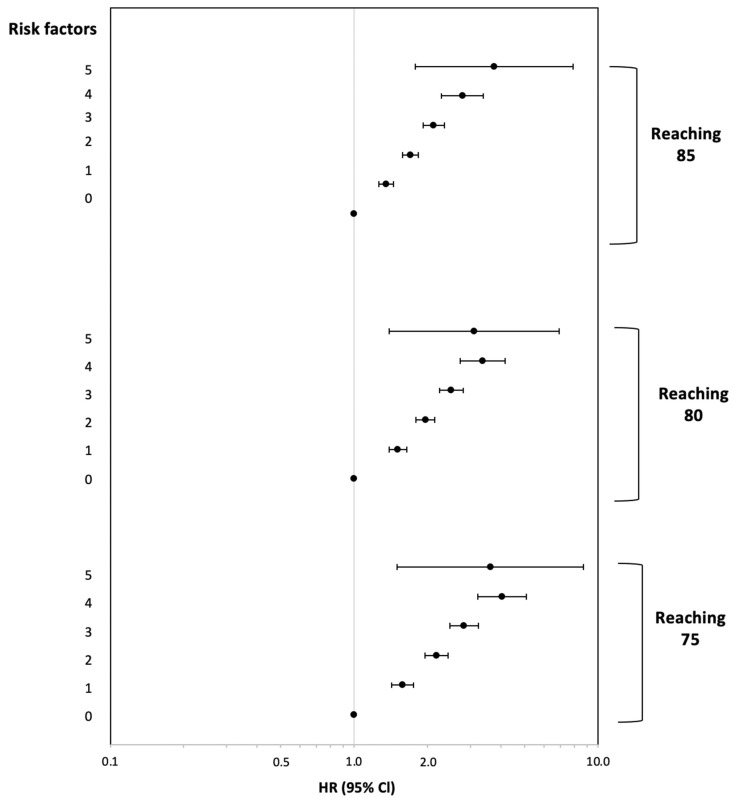
The objective of this study was to estimate the probability of long-term overall survival based on total number of risk factors (RF). We also sought to examine the role of midlife clinical, behavioral, and psychosocial predictors of longevity in a large cohort of Israeli men. This study was based on the Israeli Ischemic Heart Disease (IIHD) cohort that included over 10,000 men who were followed up for mortality over more than four decades. During the 43 years of follow-up, 4634 (46.1%) men survived to 80 years of age or older. We considered cigarette smoking, diabetes mellitus, high systolic blood pressure, hypercholesterolemia, low socioeconomic status, and serious family problems as RF at ages 40-65. Cox proportional hazards regression models, with age as the time scale, were constructed to estimate the hazard ratios (HRs) for failure to survive 80 years of age. Compared with men free of all the above RF, those with one identified RF (HR = 1.58, 95% CI: 1.42-1.75) and counterparts with two identified RF (HR = 2.18, 95% CI: 1.96-2.43) were at a significantly greater risk of death before 80. Additional RF further increased the risk of early mortality (HR = 3.62, 95% CI: 1.50-8.73 for men with 5 RF). The results suggest a role of physiological, behavioral, and psychological risk factors at midlife in predicting longevity.
§ The Valyu brief
Reading the full paper and taking notes. This takes a few seconds…
§ Ask this paper
Ask a question about this paper
Valyu reads the full text and answers from what the paper actually says.
Searching the other archives…