A meta-epidemiological assessment of transparency indicators of infectious disease models Transparency in infectious disease models
Emmanuel A. Zavalis, John P. A. Ioannidis, Chi-Hua Chen
Abstract
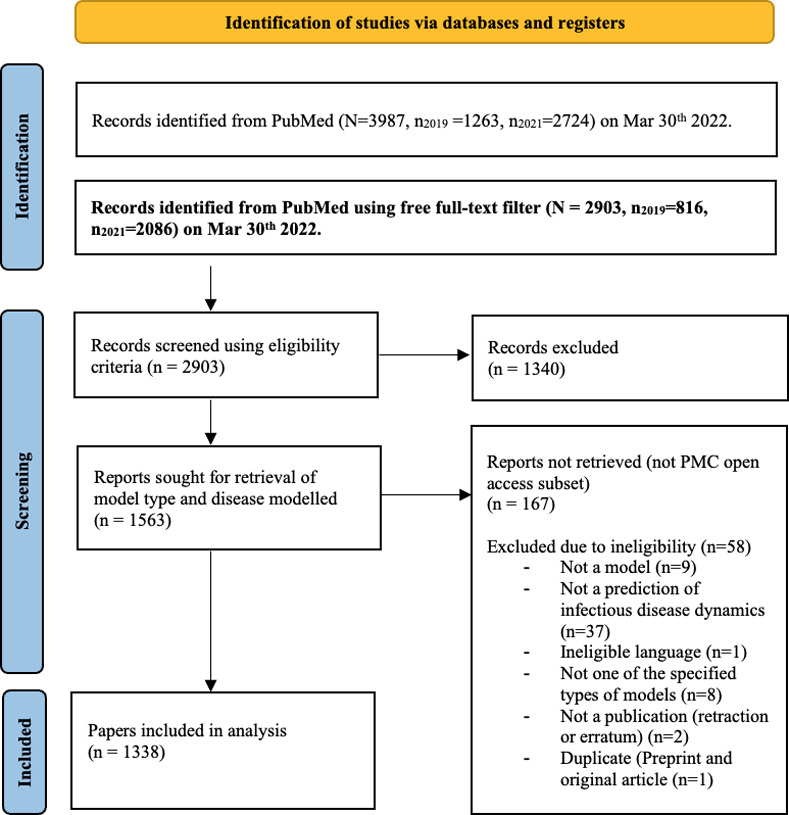
Mathematical models have become very influential, especially during the COVID-19 pandemic. Data and code sharing are indispensable for reproducing them, protocol registration may be useful sometimes, and declarations of conflicts of interest (COIs) and of funding are quintessential for transparency. Here, we evaluated these features in publications of infectious disease-related models and assessed whether there were differences before and during the COVID-19 pandemic and for COVID-19 models versus models for other diseases. We analysed all PubMed Central open access publications of infectious disease models published in 2019 and 2021 using previously validated text mining algorithms of transparency indicators. We evaluated 1338 articles: 216 from 2019 and 1122 from 2021 (of which 818 were on COVID-19); almost a six-fold increase in publications within the field. 511 (39.2%) were compartmental models, 337 (25.2%) were time series, 279 (20.9%) were spatiotemporal, 186 (13.9%) were agent-based and 25 (1.9%) contained multiple model types. 288 (21.5%) articles shared code, 332 (24.8%) shared data, 6 (0.4%) were registered, and 1197 (89.5%) and 1109 (82.9%) contained COI and funding statements, respectively. There was no major changes in transparency indicators between 2019 and 2021. COVID-19 articles were less likely to have funding statements and more likely to share code. Further validation was performed by manual assessment of 10% of the articles identified by text mining as fulfilling transparency indicators and of 10% of the articles lacking them. Correcting estimates for validation performance, 26.0% of papers shared code and 41.1% shared data. On manual assessment, 5/6 articles identified as registered had indeed been registered. Of articles containing COI and funding statements, 95.8% disclosed no conflict and 11.7% reported no funding. Transparency in infectious disease modelling is relatively low, especially for data and code sharing. This is concerning, considering the nature of this research and the heightened influence it has acquired.
§ The Valyu brief
Reading the full paper and taking notes. This takes a few seconds…
§ Ask this paper
Ask a question about this paper
Valyu reads the full text and answers from what the paper actually says.
Searching the other archives…